RTA/RTP Processes

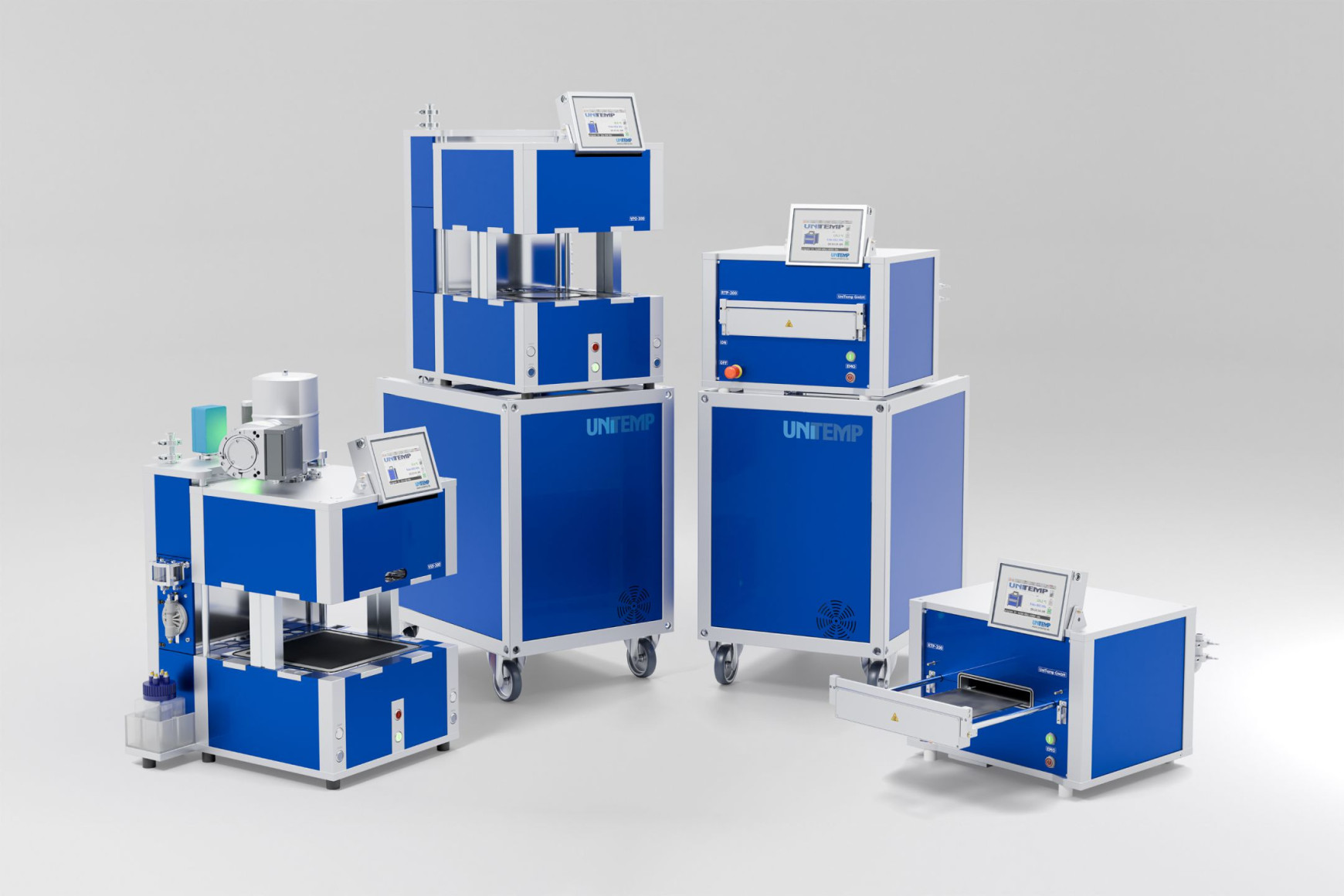
Our vacuum furnaces enable precise and efficient thermal treatment thanks to extremely low pressures, controlled process gas atmospheres, and heating rates of up to 150 K/s. They minimize oxidation and unwanted diffusion, shorten process times, and ensure homogeneous temperature distribution – for reproducible results and the highest process quality in demanding semiconductor and interconnect processes. Discover the possibilities and find the right solution for your specific process requirements.
After ion implantation – for example, in silicon, GaN, SiC, or other semiconductors – rapid heating and holding can cause defect recombination and activation of the introduced dopants (“activate dopants, repair lattice damage”). The ability to achieve high heating rates is crucial here because the goal is, for example, to minimize thermal diffusion while simultaneously reaching the necessary temperatures. In a vacuum or with an inert gas (e.g., Ar, N₂), the introduction of oxygen or moisture is prevented.

Laboratory ovens

Inert gases or process gases containing oxygen or nitrogen can be used specifically to deposit, for example, a thin oxide layer or nitrogen layer. Rapid heating and cooling rates minimize thermal stress and the diffusion of, for example, dopants or metals.

Laboratory ovens

RTP vacuum furnaces are used for processes such as SiAu, SiAl, and SiMo alloying – for example, the alloying of silicon with gold, aluminum, or molybdenum. Other applications include copper paste firing and the firing of resistive pastes. Inert gas or reducing gas atmospheres, such as hydrogen (H₂) or forming gas, can be used to reduce oxides and ensure clean contacts.

Laboratory ovens

Thin films subjected to high-temperature treatment (e.g., low-k dielectric films, amorphous films) can be recrystallized or densified using rapid thermal processing. The rapid heating and short dwell time minimize side reactions, outgassing, and unwanted diffusion.

Laboratory ovens

Our furnaces can also be used in solar cell manufacturing, such as for Si solar wafer cells on glass and Si wafer bonding. The advantages of our systems: the inert or vacuum atmosphere generated prevents contamination, and the rapid heating reduces the thermal budget.

Laboratory ovens

Since the system can create a vacuum down to approximately 10⁻⁶ mbar as well as inert gas and, optionally, reducing gas atmospheres—such as hydrogen—reduction annealing processes can be performed. Among other things, these processes are used to remove native oxides from metal or semiconductor surfaces, as well as to selectively remove or control surface oxidation prior to metal contacting.

Laboratory ovens

VPO Series (Vacuum process oven)

Precise, fast heating and cooling rates

More

How can we help you?

Are you looking for a solution for your thermal process equipment?

Contact us.